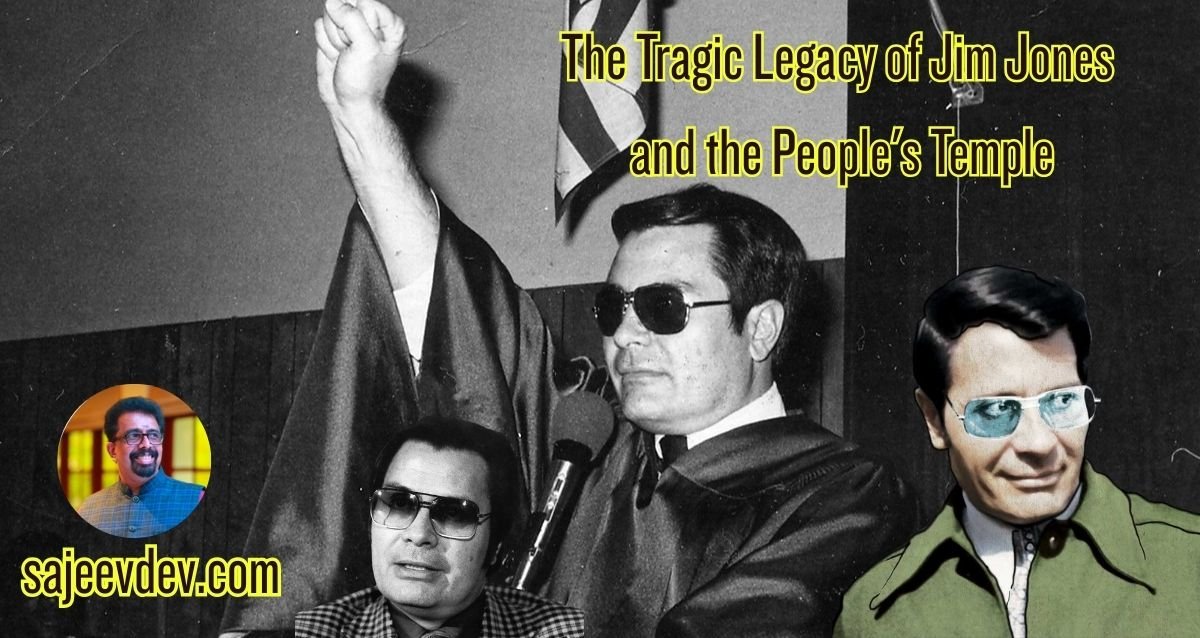

Jim Jones
Jim Jones was born on May 13, 1931, in Crete, Nebraska, into a family that would profoundly influence his early life. His father was a World War I veteran, and his mother was a nurse, both of whom instilled in him a sense of discipline and resilience. However, the family dynamics were complicated, with poverty and instability becoming part of their daily existence. This tumultuous upbringing would shape Jones’s worldview and later fuel his desire for power and connection within society.
Growing up in the midst of the Great Depression, Jones’s formative years were marked by a keen awareness of social injustices and a fascination with religion. His exposure to Pentecostalism during childhood introduced him to spirituality that emphasized fervent worship and charismatic leadership. This religious background ignited a passion in Jones, as he often emulated the dynamic preaching style of Pentecostal leaders he encountered. By his teenage years, he had already begun to engage in various ministries, demonstrating an early affinity for public speaking and the ability to inspire others through his words.
In the post-war era, as America saw shifts in social and cultural paradigms, Jones ventured deeper into the realm of ministry. By founding his first church in Indianapolis in 1955, he attempted to create a community that reflected his progressive views on racial integration and social equality. He gathered followers by promoting a message of love and healing, believing that he could create a utopian society based on these principles. The groundwork was laid for what would eventually evolve into the People’s Temple, an organization that would both embody and complicate his vision for an inclusive, compassionate community.
Founding of the People’s Temple
The People’s Temple was founded in 1955 by Jim Jones in Indianapolis, Indiana, as a composite of various theological beliefs, predominantly influenced by Pentecostalism. This era in American religious history was marked by a significant interest in new and unconventional faith systems, leading to an environment ripe for the emergence of Jones’ ambitious vision. The central tenet of the People’s Temple was the pursuit of social justice, which resonated with many individuals disenfranchised by societal inequalities. Jones proclaimed that the organization would provide a sanctuary for those seeking spiritual and tangible improvements in their lives.
<p a=”” able=”” african=”” agenda,=”” americans=”” and=”” appealing=”” armed=”” articulated=”” attracting=”” backgrounds=”” became=”” between=”” by=”” charismatic=”” clear=”” combined=”” communal=”” communities=”” compelling=”” crowd.=”” diverse=”” draw=”” drawing=”” dynamic=”” establishments.
Furthermore, Jones’ affiliations with influential leaders in the Pentecostal movement afforded him legitimacy in the eyes of potential followers. By associating with other established figures in the religious community, he was able to enhance the visibility of the People’s Temple. As the movement expanded, it began to incorporate elements of socialism, advocating for a communal lifestyle where wealth and resources could be shared equitably. This combination of Baptist roots and progressive socialism allowed for the People’s Temple to emerge as a pivotal and controversial force in American spirituality during the mid-20th century.
Civil Rights Activism and Growth
The People’s Temple, founded by Jim Jones in the 1950s, emerged during a critical period of racial tension and civil rights activism in the United States. Jones’s early commitment to social justice and equality stood out, as he actively championed civil rights for African Americans in a society marked by segregation and systemic discrimination. At a time when many religious institutions were reluctant to engage with pressing social issues, the People’s Temple presented itself as a model of racial integration. It attracted a diverse congregation that included individuals from various racial and socio-economic backgrounds, embodying Jones’s vision of a racially harmonious community.
This commitment to civil rights not only enhanced the legitimacy of the People’s Temple but also fueled its growth. Jim Jones utilized the momentum from the civil rights movement to forge alliances with influential political figures and community leaders. He became a prominent activist who spoke on behalf of marginalized communities, advocating for social and economic justice. These relationships proved beneficial, as they allowed the People’s Temple to gain considerable leverage and prominence within the broader social landscape of the time. Through this network, the Temple provided numerous social services, including food, housing, and healthcare, effectively addressing immediate community needs and contributing to its appeal.
<pmoreover, a=”” ability=”” also=”” an=”” and=”” as=”” attracted=”” base.=”” but=”” by=”” change=”” civil=”” community=”” desire=”” discourse=”” diverse=”” drawn=”” earnest=”” emphasize=”” equality=”” equality.
Shift to California and Anti-Capitalism
In 1965, Jim Jones and the People’s Temple underwent a significant transition as they relocated from Indiana to California. This move marked a new chapter for the group, who established their headquarters in San Francisco. The vibrant urban landscape provided an ideal backdrop for Jones to amplify his influence not only within his congregation but also in local political circles. San Francisco offered a progressive environment conducive to the radical ideas Jones was beginning to advocate.
Upon settling in California, Jones started to align the teachings of the People’s Temple with a political ideology he referred to as ‘apostolic socialism.’ This belief system combined his religious perspectives with radical political views, particularly those opposing capitalism and advocating for social justice. This ideological shift emphasized community cohesion, economic equality, and the eradication of societal class distinctions. Jones believed that by liberating individuals from the constraints of capitalism, he could offer them a more fulfilling life rooted in unity and shared purpose.
As Jones’s prominence in San Francisco increased, he deftly navigated the political landscape, forging alliances with local activists and politicians who shared his commitment to reform. His charismatic leadership and growing visibility allowed him to rally support for various initiatives that claimed to address social injustices faced by marginalized communities. Through public speeches, community outreach programs, and protests, Jones sought to intertwine the religious mission of the People’s Temple with broader socio-political agendas, reinforcing his followers’ belief in a radical transformation of society.
This complex interplay between Jones’s religious teachings and his anti-capitalist sentiments not only redefined the People’s Temple’s mission but also showcased the allure of his vision for a more equitable society during a time of substantial social upheaval in the United States.
The Rise of Control and Abuse Allegations
The trajectory of Jim Jones toward increasing manipulation and control over the People’s Temple is marked by a series of alarming abuse allegations. Initially, the community fostered a sense of belonging, which attracted many followers seeking solace from societal pressures. However, over time, Jones implemented an increasingly authoritarian regime. This shift towards a strict communal lifestyle imposed on believers included shared living, financial pooling, and limited contact with the outside world, all designed to heighten dependence on the temple and, crucially, on Jones himself.
As Jones consolidated power, accounts of his erratic behavior began to emerge. Former members reported instances of psychological manipulation, such as intimidation tactics and public humiliation, aimed at establishing a rigid adherence to his doctrines. This was not merely a leadership style; it became a mode of operation that instilled fear and compliance among followers. The pressure to conform grew, with dissent often met with violent retribution or social ostracism. The insistence on a shared communal life, which initially promised equality and support, turned into a mechanism for isolating individuals from their families and friends, further entrenching Jones’s control.
Moreover, reports of physical abuse became more prevalent as accusations of drug use, sexual coercion, and financial exploitation were voiced by aides and ex-members alike. These distressing accounts detailed a culture of fear where questioning Jones’s authority could lead to dire consequences. Such problematic behaviors fostered an environment ripe for emotional distress, providing a stark contrast to the utopian vision Jones had initially proposed. It became apparent that the commitment to the People’s Temple was often overshadowed by a growing atmosphere of intimidation and control, revealing the darker side of the movement’s otherwise idealistic façade.
Jonestown: A Social Experiment or an Isolated Enclave?
In the mid-1970s, Jim Jones, the charismatic leader of the People’s Temple, orchestrated a significant migration of his followers to Jonestown, Guyana. He portrayed this relocation as a bold step towards constructing a ‘socialist paradise’—a utopian community that promised racial equality, communal living, and freedom from perceived societal ills in the United States. Yet, beneath this alluring narrative lay the grim reality of a highly controlled environment, reminiscent of a prison rather than a sanctuary.
The vision of Jonestown was initially appealing to many, especially given the social unrest and racial tensions prevalent in the U.S. during the era. Jim Jones skillfully manipulated these circumstances, convincing his followers that they were fleeing from an oppressive society that sought to eradicate their socialist ideals. In this tropical setting, he aimed to create a refuge for those dedicated to his ideologies, removing them from the influences he deemed detrimental. However, this ideal quickly morphed into something far more sinister.
Once established, Jonestown operated under strict rules enforced by Jones and his inner circle. Daily life was governed by a sense of constant vigilance; members faced harsh penalties for disobedience or dissent. The restrictive atmosphere cultivated an increasing sense of paranoia, as Jones indoctrinated his followers with messaging that painted outside forces as imminent threats. In this isolated enclave, information was tightly controlled, fostering an environment where questioning Jones’ authority was not tolerated.
The narrative of Jonestown as a socialist paradise was cleverly employed to obscure the truth. Instead of a welcoming haven for those seeking social reform, it became a confining secretive commune, where personal freedoms were sacrificed for the illusion of collective ideation. Through the guise of community welfare, the darker aspects of life in Jonestown emerged, revealing it as an oppressive environment rather than the utopia that Jim Jones had promised his followers.
The Final Days of the People’s Temple
The final days of the People’s Temple, which culminated in the tragic events of November 18, 1978, were marked by a growing sense of urgency and desperation. Under the leadership of Jim Jones, the community in Jonestown was already experiencing intense pressures both from within and outside its borders. Increasingly, external scrutiny intensified as allegations of human rights abuses and psychological manipulation surfaced. This scrutiny prompted significant concern among government officials and family members of temple members.
The situation escalated further with the arrival of a U.S. congressional delegation led by Congressman Leo Ryan. The delegation aimed to investigate the reported abuses occurring at Jonestown. Despite the idyllic façade that Jones had cultivated, Ryan’s visit revealed a disturbing reality underneath. The interactions between the congressional members and the residents of Jonestown unearthed testimony from those who wished to leave the temple, emphasizing the oppressive atmosphere enforced by Jones and his followers. The confrontation highlighted the growing rift between the community’s oppressive ideals and the genuine human rights that its members sought.
<pthe a=”” airstrip,=”” also=”” ambush=”” and=”” as=”” assistance=”” at=”” attempted=”” beginning=”” but=”” claimed=”” controversial=”” critical=”” deadly=”” departure,=”” end=”” escape=”” events,=”” external=”” fire=”” for=”” four=”” gunmen=”” handful=”” his=”” in=”” intervention=”” juncture=”” lives=”” marked=”” members=”” movement.
As pressure from authorities mounted, desperation within Jonestown reached its zenith. Facing existential threats and a collapsing ideology, Jim Jones orchestrated the ultimate act of control. The atmosphere turned increasingly somber as preparations were made for the tragic mass suicide, an event that would seal the fate of over 900 individuals and mark an unfortunate chapter in American history.
The Mass Murder-Suicide at Jonestown
On November 18, 1978, a horrific event unfolded in Jonestown, Guyana, which would forever remain etched in the annals of American history as one of the most tragic incidents of mass murder-suicide. Under the leadership of Jim Jones, the founder of the People’s Temple, the community was drawn into a harrowing and orchestrated tragedy. With an unwavering sense of authority, Jones led over 900 of his followers into an act of collective self-destruction, believing it to be the only means to escape what he described as a hostile world.
The day began with a series of foreboding events. As concerns grew regarding the welfare of the Jonestown inhabitants, a visiting congressman, Leo Ryan, attempted to investigate their living conditions. His arrival led to a confrontation with Jones, igniting fears and paranoia within the settlement. Ultimately, in a united effort to silence dissent, Jones instructed his followers to prepare for “revolutionary suicide.” The sinister mechanics of this event involved the administration of a lethal mixture of cyanide-laced flavored drink, termed “Kool-Aid” by many later on.
The procedure was initiated amid chaos as individuals were methodically encouraged to consume the deadly potion, often described in terrifying detail by survivors and witnesses. Children were not spared; they were administered the poison alongside their parents, a tragic act that showcased the depths of Jones’ manipulation. The mass poisonings led to an astonishing death toll of over 900 individuals, including men, women, and children, every one of whom succumbed to the deadly concoction. This event not only claimed lives but also exemplified the catastrophic consequences of blind allegiance and the dangerous charisma of a cult leader.
Aftermath and Societal Impact
The Jonestown tragedy, which culminated in November 1978, marked a significant turning point in the public perception of cults and their societal ramifications. The mass suicide orchestrated by Jim Jones resulted in the loss of over 900 lives and shed light on the extreme consequences of manipulative leadership and blind devotion. In the aftermath, a wave of shock and disbelief swept through the United States and beyond, prompting a broader examination of cult dynamics and their impact on vulnerable individuals.
One immediate consequence was an intensified scrutiny of the term “cult.” The term became synonymous with danger and fanaticism, subsequently leading to a declining tolerance for unconventional belief systems. Media coverage of the Jonestown tragedy played a critical role in shaping public attitudes, often painting cult members as gullible or easily manipulated. This framing laid the groundwork for a more general skepticism towards non-traditional religious movements, which have historically faced criticism based on their societal structures and ideologies.
In the years following Jonestown, various cult movements emerged, some continuing to exhibit patterns reminiscent of Jones’s leadership style. New investigations into these groups often referenced Jonestown as a cautionary tale; the narrative of manipulation, control, and tragic outcomes served as a blueprint for understanding contemporary cults. Scholars and psychologists began to analyze not just the behaviors of leaders like Jim Jones, but also the psychology of individuals who are drawn to such groups. This academic inquiry has contributed to a more nuanced discourse surrounding belief and belonging, especially among marginalized populations.
Ultimately, the legacy of Jim Jones transcends the immediate horror of the mass suicide; it continues to provoke critical discussions about the nature of belief, manipulation, and the societal structures that allow for such scenarios to unfold. This ongoing dialogue is essential for preventing the repetition of history and enhancing public awareness of the signs of dangerous group dynamics.